I’m back. This time I mean it. With Colorado’s legislative session in gear and both chambers of the General Assembly up for grabs in this fall’s election, there is no time to dive into the fray like the present. While Mount Virtus may never be as prolific a place as it’s ever been. You can follow some of my other writings as follows:
Writings on teachers unions and related government labor issues at Public Sector Inc
A new less-than-regular column on education labor and related issues at Colorado Peak Politics
Nevertheless, this year you can count on this space for more coverage of events at the legislature and analysis of the upcoming state legislative elections — much like these 2010 posts on the state house and senate.
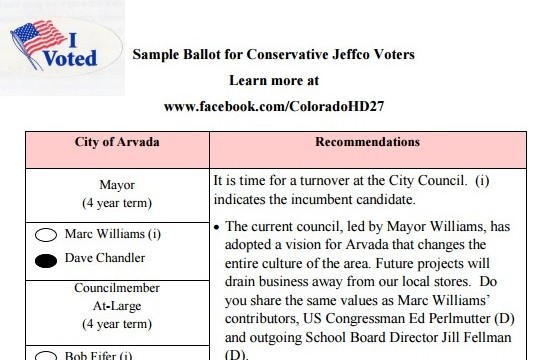
That sort of in-depth analysis will wait ’till later. For now, to whet the appetite, a quick look at House District 27 — 2010′s correctly called #1 pickup for Republicans. Democrats want it back, naturally. But given the recent reapportionment that added to the district’s GOP registration advantage, it’s an uphill climb. A month ago the liberal blog Jeffco Pols reported that Big Labor’s Tim Allport was stepping up to challenge Republican freshman Rep. Libby Szabo: (more…)
While CD 1′s hard-working Dr. Mike Fallon (#2 on the list) looks to be keeping true to his word to be a one-time candidate, the conservatives occupying the next two spots both could be back in the fray for 2012. It was more than 13 months ago I observed about CD 7 primary runner-up Lang Sias (#4): (more…)
From school board races to mill levy and bond measures, there are a number of issues pertaining to education in Colorado being decided this evening. Well known is the fate of the Proposition 103 “For the Children” tax hike — which not only crashed and burned but also disintegrated in a ball of blue-hot flame (64% No vote at last count). Two out of three Denver Public Schools board seats went to the reform ticket, with a third between challenger Jennifer Draper-Carson and incumbent Arturo Jimenez literally too close to call at this hour.
Disappointing news in my own backyard of Jefferson County, where the reform, Republican-backed “Dads” ticket of Jim Powers and Preston Branaugh were defeated. In my mind, though, the story of the night has to be in Douglas County — where a unanimous majority in favor of the nation’s first school board-initiated voucher-like program appears headed for complete electoral vindication. Other lesser-touted school board results of note: (more…)
Colorado has one issue on the statewide ballot this year: Proposition 103, a large tax hike sold as a way to increase revenues for K-12 and higher education. Unfortunately, there are two major problems with this proposal that render it unworthy of support.
First, it’s a job-killer that very well could prolong and deepen our state’s current recession. An Independence Institute issue paper by Dr. Barry Poulson finds that more than 11,000 jobs will be killed, a devastating analysis of the Prop 103 “domino” effect most creatively expressed in this amazing 3-minute video:
Complaints that public education spending in Colorado has been slashed in recent years conveniently ignore the big picture. Ben DeGrow at the Independence Institute reports that total annual expenditures on K-12, adjusted for inflation, from 1999 to 2010 have increased by $3.2 billion or 46 percent. Per pupil spending is up 24 percent. There’s little to show for it in the way of results.
As the ominous debt ceiling deadline approaches, the release of the winners of the Power Line Prize contest (“$100,000 will be awarded to whoever can most effectively and creatively dramatize the significance of the federal debt crisis”) could not have been better timed. While prominent bloggers are helping the Power Line crew count down the top entries, I have a very special and personal attachment to the 7th place winner, released today:
I’m heavily biased (take time to read the brief credits), so I’m really curious to see what six entries could have finished ahead of this “Fiscal Child Abuse” video masterpiece. Maybe the girls are so cute that they somehow downplay the gravity of the message? I don’t buy it, but that’s the only explanation I can think of why this video didn’t finish even higher.
But anyway, kudos to my Independence Institute colleagues for their creative, production and/or supporting dramatic roles: Tracy Kimball-Smith, Amy Oliver, Todd Shepherd and Jon Caldara. For their sakes and for mine, take the two and a half minutes to watch it all, especially the outtakes at the end. You’ll be entertained and educated!
In my official capacity at the Independence Institute, I helped to create this newly-released video (narration by Mary MacFarlane, editing and production by Justin Longo, consulting and oversight by Jon Caldara and Pam Benigno):
As my juvenile alter ego at Ed Is Watching pointed out:
…it’s a story like 13-year-old Nate Oakley’s that brings to life the need for Douglas County vouchers, and the real threat created by lawsuits filed by the ACLU and other groups.
Find all the resources you’ll need to follow the developments and ins-and-outs of the Douglas County Pilot Choice Scholarship Program on the Education Policy Center website.
In yesterday’s Denver Post Perspective section, hoary-bearded columnist Ed Quillen further expounded on his ignorance of 19th century American history, with particular venom directed at the Douglas County Choice Scholarship program. Under the almost-witty headline of “Thou shalt smite vouchers” Quillen takes a leap of faith that goes something like this (I’d insert a direct quote or two but am not interested in attracting the costly legal animus of Righthaven):
Leading 19th century American politician James Blaine had a Catholic mother; therefore
The Blaine Amendment he crafted into the state constitutions of Colorado and numerous others were bastions of modern “secular” thought promoting the separation of church and state, as understood by the ACLU and its compatriots; therefore
Republicans in the 1800s were much more secular and enlightened than their contemporary counterparts; and
Forget the fact that parents are given a choice, the Douglas County school board is funneling money to religious schools in violation of a benign state constitutional provision.
Really? Bad history may make for clever political potshots, but beyond that it has little practical use. The leading flaw in Quillen’s column is a fundamental (and willful?) misunderstanding of 19th century American public education — which was “nondenominational” Protestant but clearly not secular as the columnist imagines. (more…)
A lot has happened in the month since I last posted here about the open negotiations controversy in Jeffco Public Schools. I was glad to see Mike Rosen bring attention to the issue on his show and in his May 12 Denver Post column, in which he concluded:
A number of other states have laws mandating that negotiations between government-employee unions and government agencies be open to the public. In Colorado, that decision is currently left to local government. Colorado law is generally friendly to public openness and disclosure regarding government meetings and documents. Since a majority of funding for public-school districts in Colorado comes not from local property taxes but from the state’s coffers, the state legislature clearly has standing to join other states in passing a uniform law opening these kinds of negotiations to the light of public scrutiny.
As I reported in my 2010 Independence Institute issue backgrounder “Colorado Education and Open Negotiations,” six states currently have laws on the books guaranteeing this brand of taxpayer-friendly government transparency. In Colorado you have to go back to 2005 for Senate Bill 175 and to 2004 for House Bill 1242, the legislature’s last serious (and in the case of 1242, nearly successful) attempts to shine light on negotiations between governments and unions. With momentum growing locally around this issue, might Colorado lawmakers try this approach again? (more…)
I don’t watch cable news, and I definitely don’t watch MSNBC. But I found this creative 30-second video of Rachel Maddow sends a pretty powerful message about the debt crisis our nation currently faces… take a moment and watch:
Slipping under the radar late in Colorado’s legislative session (sine die is tomorrow, hallelujah!) is House Bill 1320 — sponsored by two conservative Republicans, Rep. Janak Joshi and Sen. Bill Cadman — a rare two-page piece of legislation that would essentially outlaw collective bargaining in state and local governments. It’s not going to pass, and concerned citizens and political observers rightfully are paying attention to Colorado’s redistricting debate instead, so it’s not worth expending too many pixels.
Rep. Keith Swerdfeger, R-Pueblo West, who owns a heavy construction company, said he can’t vote for the bill.
“I have been a union contractor the entire length of our contracting for 40 years,” Swerdfeger said. “We always came to the table and were able to reach an agreement.
“I would not support the bill. Our relations with the unions have been pretty good over the years.”
On FOX 31 last night, political reporter did a sit-down with Governor John Hickenlooper for one of the School Cuts 101 series segments. The result? Unremarkable. Hick has been focused on budget issues, rightly so, and education reform barely shows up on his radar screen.
Lt. Gov. Joe Garcia is the administration’s point-man on education issues. Last week at the Capitol he presented the three-point education agenda. Finding money to implement SB 191 — last year’s significant teacher and principal evaluation bill — is a worthy cause. But tackling the state’s serious 3rd grade literacy shortcomings by traveling the state to ask school districts for their input? Sorry. Try this approach instead. (The third part of the agenda, promoting college completion through the implementation of statewide articulation agreements, is outside my expertise.)
But most of the questions Stokols posed to the governor are largely predicated on some other parts of the School Cuts 101 series. Mainly first, should Colorado updated its school funding model based on an Oregon proposal that allots a share of dollars based on performance? (The idea has some merit in theory, but the Cascade State approach dangerously seeks to consolidate and centralize power.)
I know the timing is impossible for it to be true, but you’d almost think my first School Cuts 101 response piece triggered some interest from the FOX 31 team with my cryptic closing:
Anyway, looking for real ideas for how to make education spending more productive and promote better outcomes for students? One good place to start is my chapter on K-12 for the Independence Institute’s Citizens’ Budget. Or check out what Colorado school districts like Douglas County and Falcon 49 are up to. More on that later… [emphasis added]
In hindsight, we’re probably just on the same wavelength. Or maybe it’s impossible for FOX 31 to ignore the groundbreaking educational changes emanating out of Douglas County. In any case, I’m pleased to see their coverage of the suburban school district’s Choice Scholarship Program, along with a great example of how the program expands options for parents.
For the most part, beautiful. Of course, being a news story, they rightfully reported the views of the opposition:
“I feel that the program will take money away from schools in a time when we desperately need money. We are cutting everything,” said Delana Maynes, with Taxpayers for Public Education. “You still have to pay teachers. You still have to turn on lights.”
Local FOX 31 Denver News and reporter Eli Stokols are to be commended for wanting to look at the effects of K-12 education spending cuts and innovative ideas for addressing the challenge. But the first edition of the televised series cries out for context and correction. First of all, it’s important to stress that yes, for the past couple years Colorado schools have been experiencing real budget cuts — after years of steady increases in per-pupil funding. And of course, the cuts will have an impact, albeit an impact that can be heavily mitigated and overcome in the long run by re-thinking how our school system does business.
That being said, the “crisis” trumpeted in Stokols’ piece is painted in a dubiously overstated light. It all begins with the following graphic that purports to show Colorado K-12 spending in a long-term decline: